Take heart, Teacher, and be encouraged. You will be appreciated.
Public school, private school, charter school, home school. College prep, unschooling, classical education, laid-back eclectic. Academics, sports, fine arts, technical skills. Parenting.
Tie a shoelace. Learn to add. Hit a home run. Play Mozart. Give a speech. Ace the ACT. Be kind to others.
Prepare a meal. Milk a goat. Change a tire. Serve food with flair. Repair equipment. Lead well. Help others heal.
Teacher, whatever your official title, you enable others to become who they are meant to be.
Teacher Appreciation Day may bring you many gifts. It may bring none. But there are times when current or former students think kindly of you and know without a doubt that you are a part of their success stories.
Perhaps it will be on Graduation Day. Maybe it will be the day your student becomes a teacher. It may be the day your pet died; the week you are kicked and spit upon; the day you stood up for the underling; following weeks of encouragement to struggling learners; your patient, consistent correction of bad behaviors; your flair for presenting history or making math class fun.
If it is not today, Teacher, be patient. Appreciation is there, and one day you will see it. And it will be so sweet.
Now Always Forever Never Tomorrow Yesterday Today Just give me a sec In a minute Sometime
Time is such a weird thing. An afternoon spent laughing with friends is gone in the blink of an eye. An hour spent staring at a math test when you can’t remember any of the formulas seems like eternity. To the grandparent who wants to give gifts to over twenty grandchildren, you turn around twice and it’s Christmas again. Meanwhile, to those children, from Christmas to a birthday is for-ev-er!
Last night we had a little talk about how to get children to understand that the choices they make now are setting a pattern for the rest of their lives but the consequences are so much greater as you get older. Well, for this particular child we now need to be prepared for questions like “Do you have enough money to pay the mortgage?” “Can we pay the light bill this month?” “Are you sure we can buy enough food?” “Have you done anything to go to jail?” “What’s so bad about losing a job? You did and you’re okay.” I’m thankful he has learned to look at a calendar and wait for days and weeks until an event. He counts hours or minutes with exactness. He counts months until his birthday. But when it comes to things other than a specific event, then and now are not easily distinguished. At that moment in the conversation, I had a lightbulb moment. Some children, and I realized this morning a number of adults I know, live in eternity. Everything is now and everything is always. That trait is maddening to those of us who live by a calendar and a clock, even if I do round times to the nearest quarter hour, which in turn drives my be-precise!-minded friends crazy.
I awoke thinking about that concept. Everything is now. Everything is forever. I hope that on the other side of this life I have a new brain, because this one can not quite grasp the idea of life without time that steadily moves forward. In the meantime, perhaps I will be a little more gracious to those who seem to have no sense of time, and more thankful for those who do live by a clock and a calendar.
If possible, as far as it depends on you, live at peace with everyone. – Romans 12:18 CSB
“Stick your finger into the soil. Can you feel any moisture?”
“Oh yeah! Just a little bit of it is dry. Then it’s damp.”
“Well, you need to wait until the soil is dry almost to the bottom of the pot and then water it.”
“Oh. Okay. But why?”
Years ago in what seems a different lifetime, a wholesale supplier told us that the perfect time to water a poinsettia is fifteen seconds before wilt. So … when is that? You can’t see wilt until it happens. If you have tables full of plants, you can wait until a few near the edges wilt, and then most of them are just before wilt, and a few may be watered a little sooner than they really need it, but they will be okay. But if you have just a few plants around your home, how do you tell? And why does it matter?
One way to tell is to check the soil mixture. Stick your finger in it and see if it’s wet or not. There are also cute little glass bulb thingeys that somehow let water out only when the soil is dry. There are fancy soil moisture sensors that will tell you when to water.
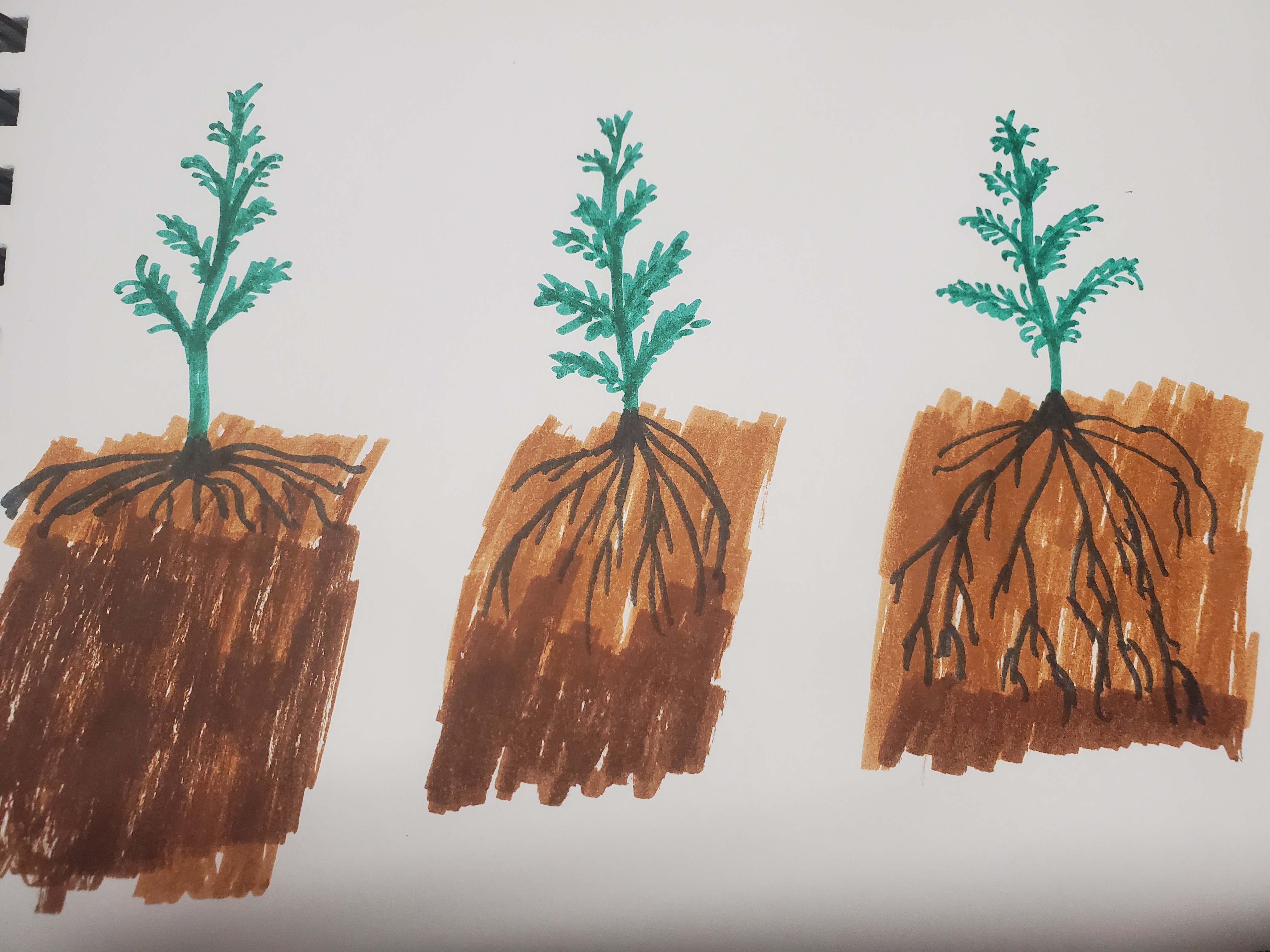
Why is it important? If you have a plant or two that you will keep indoors, it may not really matter. But if the plant is outside in the wind or will later be transplanted to the outdoors, it needs roots. It needs lots of roots. It needs deep roots. Plants are efficient. They will grow roots only long enough to reach water and nutrients. If water is nearby, the roots stay short. When the winds come, the plant is easily blown over. If the roots have to reach deep for water, they will. Deeper roots give the plant more stability.
Deep spiritual roots give us more stability, too. Often we want to go to a retreat and grow our spiritual lives during the celebrations of life. Celebrations and mountaintop retreats are nice, but much more often our faith is grown during the troubles of life. We usually pray for our troubles to be fixed or to simply be poofed away as if by magic. Troubles can be our allies. They show us who are supportive friends are. They give us an opportunity to use the skills we have learned. And they teach us new skills that will help us later on. Perhaps, instead of praying, “Fix this, God. And do it NOW!” we should consider praying, “God, I don’t like this. You know I don’t like it. You know this is hard. Please help me see what I need to learn. I know I am learning to depend more on you instead of my own abilities and resources. May this experience help me to become closer to the person you want me to be.”
Not only that, but we rejoice in our sufferings, knowing that suffering produces endurance, and endurance produces character, and character produces hope, and hope does not put us to shame, because God’s love has been poured into our hearts through the Holy Spirit who has been given to us. – Romans 5:3-5 ESV
And then one day, one moment, the questions change.
Where am I now? Where am I to go?
How will I get there?
What do I need to learn to get there?
Who should I be following?
When will I start?
We are here – at this time and in this place.
Where we go as a community or nation is dependent on a lot of things beyond any one person’s control. Where each of us goes individually depends largely on the decisions we make as individuals.
We will depend on our faithful support group, and our God.
We will probably learn that we need to learn more than we can, but we will do the best with what we know at any given time. We will seek to increase our knowledge and our wisdom.
We must act in a way that reflects who our mouths say we are following.
My mind has been wondering around in hyper drive lately. This morning I wandered outside to sit in the sun. Sunshine, no breeze, and 45 degrees is pretty nice, especially with everyone else in the household asleep and no traffic on the road.
I have been wondering about the fear and uncertainty in our world. They are consuming people like a prairie wildfire at the end of a year of drought. What are we so stinking afraid of? The unknown. The uncertainty.
I recently heard the remark, “Why would anybody have a baby NOW?” I also heard that in the 70s – the cold war and the imminent threat of mutual annihilation kept a lot of people in a state of fear. In the early 21st century, students were shot at school. Unprecedented! No, it wasn’t’. Violence tore at schools and communities in the 1960s during the Civil Rights Movement.
That brings to mind the War Between the States. Imagine a family with several sons, and those adult sons choose different sides. As far as the deadliest attack on American soil, we did it to ourselves in that war. Can you imagine living in Virginia, or any other border state, in 1863 and finding out your first grandchild would be born in a few months? Will the doctor be available if something goes wrong? Will the town still be here? Will my home be mine or full of soldiers? Will we have any food or will the military have taken it all? There was no social security or food stamps or aid for families with children. It was you, your family, and your community.
Going a little farther back … what about the American Revolution? It’s easy now, close to 250 years later, to choose a side. But what if you were living then? What if you valued the steady income from sales of your products to England and your brother wanted to stop paying a government to tell him what he could and could not do?
Disease and pestilence have caused havoc in the past, too. Few people seem to remember H1N1 in 2009, when schools were shut down here and there, not nationwide but as needed, for months. That pandemic officially lasted sixteen months, from April, 2009 to August, 2010. HIV, Hong Kong flu, polio, the influenza outbreak of 1918, the Great Depression and the Dust Bowl, locust swarms, Black Death, and a host of other things that I don’t even know about.
We think of being born into a royal family as a great thing, but was it really? An uprising that resulted in a new family leading the country could mean the death of everyone in the deposed family. That practice has gone on for millennia. Not much of a problem, perhaps, for the peasants, but for those on the edge of royalty I imagine any uprising brought quite a bit of stress from uncertainty.
So what?
This is what. Uncertainty is almost as old as humanity. Fear is as old as uncertainty. Today is not the first day ever of many people wondering what the future holds, with many hopeful and many fearful. Covid is not yet the deadliest disease ever. It may be the most uncertain day in your lifetime. It may be the deadliest disease in your lifetime, but before you are sure of that, do a little research.
I am sure of a few things. God did not start caring for people just yesterday. He has walked beside us and carried us from the beginning of time. He has been with his children for millennia. He is able to strengthen us through whatever the future holds. We hold to this hope because he has done so in the past. Bad stuff happens to people who follow God and people who don’t. Our happiness depends a little on what happens to us and around us and a whole lot on how we respond to those things. Our joy is found in resting in the arms of God.
May you have a joyful day, whatever your circumstances.
It rains on the just and the unjust. – Matthew 5:45
The joy of the Lord is your strength. – Nehemiah 8:10
Have you been around a toddler lately? A little child who is just learning to talk? What’s that? Who is that? What’s that? What’s this? Every breath seems to be a question. By the age of three the question is “Why?” No matter how many times you answer, their reply is “Why?” We begin life as curious creatures. It’s how we learn about our world and ourselves. Head, shoulders, knees, and toes, knees and toes. You sang that didn’t you? We learn what, who, where, and eventually when, how, and why.
Fast-forward to adulthood and we are still curious. What’s that noise?! Oh, it’s just a cat outside the door. Why in the world would anybody do that? What caused this cancer? Why are those flowers sometimes blue and sometimes pink – on the same bush? Is it supposed to rain this weekend? Will it really be that bad if I don’t take this medicine the doctor prescribed? How many times can one child spill a glass of milk – during one meal? Where do the memories go?
Sometimes the answers are easy to find, like the cat outside the door. Some are a bit exasperating, like how many times can the milk be spilled. Some are mostly fun, like what makes a hydrangea blue or pink. Some create conspiracy theories, like why would anybody do such a thing, whatever “that thing” happens to be.
I don’t know if curiosity has really killed many cats, but it has gotten some people into a bit of a pickle. You know as many of those stories as I do. Someone is curious enough to eavesdrop but not curious enough to clarify the details. The story gets passed along and changed and eventually gets back to the original speaker, who laughs hysterically at the ridiculousness of the story. Or, they get mad and create a scene and go try to straighten out all the details to everybody. Either way, it’s just a mess.
And then there’s the dig for facts kind of curiosity. Once upon a time you had to know people who knew things or read books to find information. Now, you just ask Siri or Alexa or Google. And if it’s on the internet, it has to be true, right? We all know that, sadly, that many things on the internet are not true. Distinguishing the facts from opinions can be difficult. Even more difficult is distinguishing true information from twisted information. New information compounds the difficulty of knowing what is “true.”
Just a few tidbits from history –
Bloodletting is a cure for disease. Tomatoes are poisonous.
Pewter, a popular material for drinking vessels, was made of lead. We used lead in water pipes and paint for our walls and furniture without causing any harm.
Thermometers were made of glass with mercury inside. Shoot, we safely played with little balls of mercury after the thermometer broke.
At points in history, these were considered true. We have learned differently. To believe that we at this point in history have a complete and thorough understanding of what is safe and what is not is to be dangerously arrogant. To settle on an opinion and be closed to new information on a topic – whether it is what fabrics to use for clothing or masks, what kinds of food to eat, whether to wear a mask or get a vaccine – is to risk looking as silly as those people you think were pitifully ignorant in years past.
During times of unrest or uncertainty, the Christian church often turns to 2 Chronicles 7:14. The intent of calling ourselves to repentance and into line with God’s purposes is a good idea. Many Christians have a solid understanding of the verse.
if – The promise that follows is contingent upon a condition being met.
my people who are called by my name – Not the whole world, just those who claim to belong to follow God’s teachings.
will humble themselves – While few of us will admit to being prideful, we are quick to pray for God to correct this sin in others.
and pray and seek my face – This is the easy part – telling God what we want Him to do.
and turn from their wicked ways – Again, we are quick to pray for all those others who claim to follow Christ but don’t agree with us. We need to sincerely seek God and listen to Him when he tells us what changes we need to make.
then – We like this part. Here comes the promise!
I will hear from heaven – what a joyous thought, God hears us.
and I will forgive their sin – We all need this.
and heal their land – Many want this. We want God to fix our nation, and all the people in it, so that we all get along.
We lose a lot of meaning when we take a verse and focus on just the verse. I am all for memorizing verses of scripture and no, I don’t think I could memorize the whole chapter. However, while we are memorizing, we need to become familiar with the context. King David is dead. Solomon has overseen the building of the temple. During the dedication of the temple, Solomon spoke to the people and then prayed to God. Fire came down from heaven and consumed sacrifices. God’s glory filled the temple so that the priests could not enter it. The leaders and people worshipped and offered more sacrifices. They feasted for a week and held a solemn ceremony on the eighth day. Solomon sent the people home. And then the Lord appeared to Solomon during the night and says that he is has heard Solomon’s prayer and chosen the temple as the place for his sacrifices. Then he says that when disasters strike, if his people will call out to him and repent, he will rescue them. I would be thinking, “Seriously?!?!!! After the way you just this week showed your glory and we worshiped you, you’re going to bring calamity on us??!!” Lest you think I exaggerate, let’s look at verse 13. By the way, there’s a comma at the end of verse 13; when we start at the beginning of verse 14, we are starting in the middle of a thought.
When –English translations are about 50/50 on whether this word should be “when” or “if.” Throughout scripture, the Hebrew word is an interjection that is most often translated, “behold” and is also translated as “so,” “through,” “when,” and “if.” Most of these words give the sense that God will cause the following things to happen.
I shut up heaven and there is no rain – Most of us have lived through times of drought. In this message to Solomon, God is saying He himself may shut the heavens. Even with our current water supply systems, if it doesn’t rain for months, we are in trouble.
or command the locusts to devour the land – They don’t eat the literal land – the dirt – but the vegetation on it. They leave behind no tender growth. No crops. No food.
or send pestilence among My people, – Plague, disease, and epidemic are more common words today.
To wrap it up in laymen’s words …. The nation of Israel held a great feast celebrating the dedication of the Temple. The worship was wonderful. After everyone had gone home, the Lord came to Solomon during the night. He told Solomon he was pleased and that if troubles came, serious nation-wide troubles, the people could turn back to God and his teachings and God would heal the land. When life is going great it is easy to get our eyes off Jesus and onto the things of the world. We get into a place where we seem able to care for ourselves without any divine strength or guidance. We have a good job, a safe home, a government that protects individual rights, a family we can visit, generally life is grand. And then troubles come. Then we realize that maybe, just maybe, we do need some supernatural guidance and wisdom and strength to navigate this life.
May 2 Chronicles 7:14, in context, still bring you comfort. Even when the food supply is disrupted and disease runs rampant, even when troubles surround us, we can sincerely turn to God and he will hear us and heal us. What a blessed promise.
These words can sting. They can cut straight through your heart. But, sometimes, they are just the push you need to begin healing. If we stay mired in our past hurts, it is really difficult to grow where we’re planted now, much less flourish in any area of life. Children can be great at moving on. They can have an intense argument over a toy or which game to play and five minutes later be involved in a completely different activity and having a great time. On the other hand, many adults avoid certain people because, “I just can NOT listen to that story AGAIN!” I’ve done it. You have probably done it. I have been that person telling the same sad story. Maybe you have, too.
Telling our story is part of our coping mechanism. Sharing our journey is part of how we heal. Some folks can tell it once – or not at all – and get on with life and be just fine. Others of us need to know that someone cares that we hurt. The event was painful then and the dull ache, with no warning whatsoever, will erupt in tears or anger or despair. We try to move on but the past keeps weighing us down.
But … is remembering all bad?
I had been in church for decades before I ever heard a pastor question the theology of the songs we sang. As it turns out, that’s a good thing to do. I also learned that for generations we have sang songs without knowing what we were saying. In the familiar “Come Thou Fount of Every Blessing” is the line “here I raise my Ebenezer.” What’s an Ebenezer? According to the Mirriam-Webster dictionary, it is a commemoration of a divine intervention. In I Samuel 6 and 7 is the story of a clash between the Israelites and Philistines. Just before the battle, God confused the Philistines and Israel was easily victorious. “Samuel then took a large stone and placed it between the towns of Mizpah and Jeshanah. He named it Ebenezer (which means “the stone of help”), for he said, “Up to this point the Lord has helped us!”” (I Samuel 7:12 NLT)
How has the Lord helped you up to this point? What is your Ebenezer? Traditionally it is a stone. Essentially it is something to remind you that God has helped you up to this point. Knowing God has helped you to this point is encouragement that he will help you through the next struggles, too. Your Ebenezer may be a journal you keep of prayer requests AND answers. It may be a ring, symbolizing the love and all the craziness and joy of sharing lives. It may be an urn of ashes on the mantle and you still get up, get dressed, and get through each day. It may be a picture of you on a trail because you can again walk up a hill. It may be a degree hanging on the wall. It may be a hand-drawn picture held to the refrigerator by a magnet.
If you don’t have one, find your Ebenezer. Forgetting is not the key to moving on. Remembering the joys and cherishing how God carried us through the trials will help us get through the uncertainties of the future.
“It’s beautiful.” The words seemed to escape with a sense of wonder and awe from our eight-year-old grandson.
“They’re broken.” Disappointment rang through my words.
We were putting away Christmas decorations. In the process, we went through a box of stuff, including boxes of glass ornaments, that we did not use this year. Whoever packed it up was careless or did not think things through. Roughly one third of the larger ornaments in the bottom box were crushed by the weight of other items in the box. At first glance I saw poor packing and brokenness. His first impression was the beauty of the inside of the broken ornaments.
“It’s beautiful.”
“They’re broken.”
“But Nannie, they’re beautiful.”
A pause.
“Nannie, they’re just like people. They might be broken on the outside but on the inside they’re beautiful.”
Leave it to a child to find the lesson in a box of broken ornaments. Not always, but often enough that we should pay attention, people are beautiful on the inside even when they’re broken on the outside. I have read words of thankfulness from more than one recovered addict: for those who believed when even they themselves could not; for prayers when they weren’t so sure that any god existed, much less a God of love and restoration; for those who believed in the potential of a healthy life even when a relapse happened. I have seen the emotionally downtrodden carried by the presence of friends. I have seen the mentally fragile thrown a rescuing rope by loved ones. I have seen the physically struggling supported by friends and neighbors. I have seen spiritual seekers gently drawn into a fellowship by love.
I made the picture after we had removed most of the ornaments. I think there’s even there for us to see another lesson. Not one small ornament was damaged. Not one. That’s easy to explain; they were shorter and no pressure hit them. We need to be that way, too. Physically and spiritually. It’s easy for us to see the need to protect babies and young children. Sometimes we forget, especially if someone comes to faith in God as an adult, that spiritually they are babes. They nurture, guidance, and protection for a time.
What would the world look like if everyone who professes the belief in a God who cares about the world treated the people around them as if they are beautiful on the inside? What if cared for the spiritually young just as we do for the physically young? Not one of us can change the entire world, but every one of us WILL change the world right around us. Will we see the brokenness and through it away? Will we see the beauty and treasure it? No, I didn’t rescue any of the broken ornaments. But people are valuable in God’s sight and should be in ours. May each of us who profess to believe that act like we believe it. May each of us choose to be a beacon of light pointing to God and his love.
I want to write something light-hearted, something that will bring a smile and perhaps even a belly laugh to anyone who reads it. However, my heart refuses to go there right now.
I am blessed to belong to a small group of women who gather to study God’s Word. We are currently working through Jen Wilkin’s The Sermon on the Mount. Most likely, you will recognize parts of these three chapters in the book of Matthew. Treat others the way you want to be treated. Judge not. Give us this day our daily bread. The wise man builds his house on a firm foundation. Blessed are the peacemakers. Don’t throw your pearls to the pigs. If your right hand does something offensive, cut it off. Pray in secret. Don’t worry. God cares for the birds; he cares for you. The list goes on.
The way I summarized some of those things is misleading. The way many are used in everyday conversations is not aligned with the meaning you get when you read it as a part of the entire sermon. And seriously, who among us wants anyone to take a few words of ours and twist them around to mean something we didn’t intend? I don’t think Jesus likes that, either.
Prior to this study, I was familiar with the Sermon on the Mount. Like many other Christians, I have never read it as one sermon. Doing so adds much depth to many of the stories with which we are familiar. When you add explanations of first century Hebrew customs, God’s grace and calling to us is even more evident. No, Jesus did not intend for people to go around maiming themselves for their sins. He used exaggeration to drive home some of his points. Some of the passages that seem harsh to us today can be seen as merciful and uplifting when you know the practices of those days.
As we progressed through the study, I often found myself grateful when I read the questions to make you think and apply the scripture to your life. “Oh, I’ve already handled that.” “Oh yeah, I had a problem with that, but thank you God, not now.” “Whew! I’ve never even struggled with that one!” Knowing I am still very far from perfect, I was beginning to feel a little proud of my spiritual growth.
And then. Oh then. That evening. The boys had stretched my patience, compassion, and understanding so that it was thinner than six pound test monofilament fishing line. Another mischievous act. More disrespect. And then, upon my notice of discipline, “That’s not fair!” I lost it. I used words I hate to hear adults use when no children are around. They did calm down and play very nicely for the rest of the evening.
Meanwhile, I was in a state of confusion, sadness, remorse, and conviction. If what comes out of our mouths reveals what is really in our hearts, what is in my heart that is so dark? That attitude and those words are not an example of being righteously angry and sinning not. Had I missed everything God was trying to tell me through this study of Jesus’ longest recorded sermon? Had I been so focused on past success that I couldn’t see the current changes needed to become more like the follower God wants me to be? Of course I spent some time in prayer, alone and with a trusted friend. The boys and I rested well. We all snuggled the next morning. A mistake is not the end of all things good, even when it does cause a bump in the road.
As I scrolled through social media the next few days, it was obvious I am not alone. Many of us who call ourselves God’s children need to have a wake-up call. We need to see ourselves not as we have grown to see ourselves, not as we want God or others to see us, but as we are. Only when we see the brokenness and sincerely leave it at Jesus’ feet can he begin to heal us, and we all need his healing.





 Wondering, Wandering, and Writing